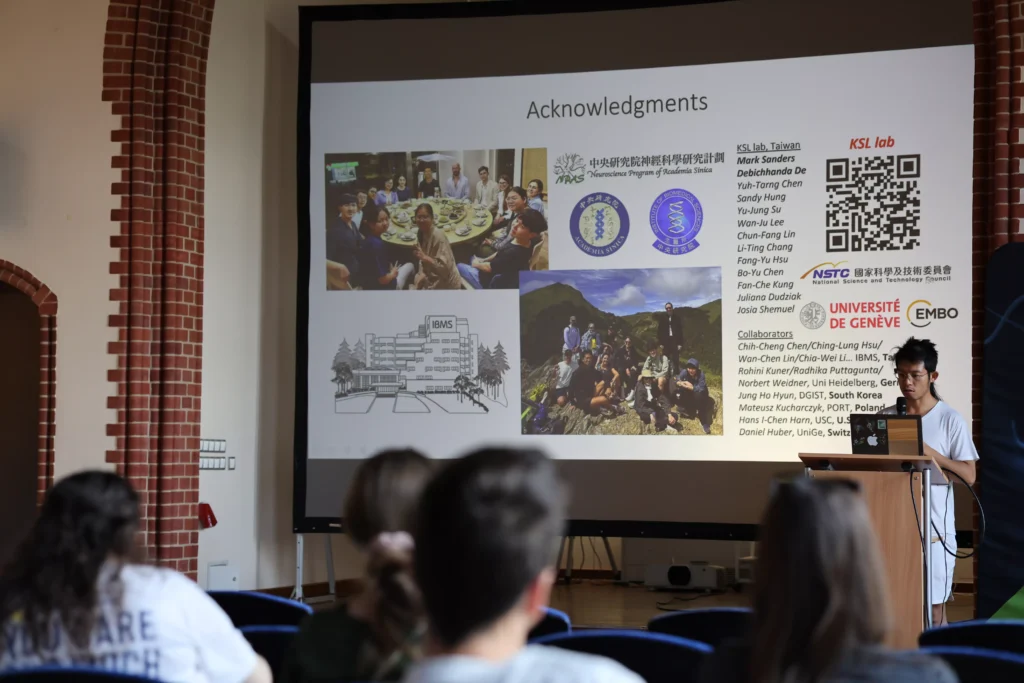
To move with precision, an animal must know not only what is happening around it but also what its own body is doing. This internal sense of position and movement—proprioception—depends on mechanical signals generated as muscles, joints and tissues change during behaviour. Mammals and cephalopods solve this problem with very different bodies and nervous systems. These questions formed the focus of an open seminar held at Łukasiewicz – PORT on 2 July 2026 by Dr. Kuo-Sheng Lee of the Institute of Biomedical Sciences, Academia Sinica in Taipei, titled “Sensing the Environment and Self in Mammals and Cephalopods.”
At the centre of the seminar was a fundamental problem in sensory neuroscience: how the nervous system separates and combines information about the external world with signals produced by the body itself. Mechanical stimuli are especially useful for studying this boundary. Touch can originate outside the organism, while stretching, pressure and vibration can also arise from its own movements. Receptors in peripheral tissues convert such physical forces into neural activity, and the central nervous system must interpret that activity quickly enough to guide posture, movement and ongoing behaviour.
Lee’s broader research on mammalian somatosensation illustrates how this processing begins at the sensory periphery and is transformed as signals ascend through the nervous system. His work includes studies of vibration-sensitive mechanoreceptors and of how vibrotactile information is represented in the brainstem. Research on the Pacinian corpuscle, for example, has shown that its lamellar Schwann cells are not merely passive structural elements: they can contribute actively to the sensitivity of this vibration receptor. Such findings complicate the traditional picture in which mechanosensation is treated as a function of sensory nerve endings alone.
The comparison with cephalopods shifts the same question into a radically different biological setting. An octopus controls eight highly flexible arms without the rigid skeletal constraints that simplify movement in vertebrate limbs. Its arms can elongate, shorten, bend and twist, creating a demanding problem for sensing limb state and coordinating movement. The scientific scope of the seminar connected proprioception and arm control with camouflage, wound healing and the regeneration of complex neural circuits. Cephalopods are able to regenerate nerves and entire appendages, making them valuable comparative systems for asking how sensory and motor function can be rebuilt after injury.
This cross-species perspective is important because evolution does not have to produce the same anatomy to solve the same functional problem. Mammalian and cephalopod nervous systems must both estimate body state, integrate it with environmental information and convert sensation into action, yet they do so with very different neural architectures and biomechanics. Comparing these solutions can reveal which principles of sensorimotor control are broadly shared and which depend on a particular body plan.
Lee’s research programme combines several methods that operate at complementary scales. Two-photon imaging can monitor activity in identified neural populations with high spatial resolution, while holographic optogenetics allows selected cells to be manipulated with light. Electrophysiology provides direct measurements of electrical signalling, and closed-loop behavioural experiments make it possible to relate neural activity to an animal’s actions as conditions change in real time. Used together, these approaches help connect mechanotransduction at peripheral receptors with circuit processing and behaviour.
By placing mammals and cephalopods in the same scientific frame, the seminar connected basic questions about touch and proprioception with broader issues in motor control, comparative neurobiology, neuroprosthetics and regeneration. It also showed why studying organisms with very different evolutionary histories can expand the set of biological solutions available to neuroscience and bioengineering. Open seminars of this kind create space for researchers from different fields to compare concepts, methods and experimental models around a shared problem.